

HEIGHT
58 - 71 cm
WEIGHT
16 - 29 kg
LIFE SPAN
12+
GROOMING
Weekly
COLORS
Variety of Colors

ARABIAN SALUKI - BREED DESCRIPTION
23 - 28 in
35 - 64 lb
This slim-framed, sleek, and intelligent gazelle-hunter makes a loyal and courageous family companion


Salukis have a long highly romanticized history. it is one of the oldest breeds in existence, Saluki-type dogs have been used as hunting dogs for thousands of years. They are shown on wall carvings from the Sumerian empire (in what is now Iraq), dating from 7000-6000BCE, and on paintings in Ancient Egyptian tombs; their mummified bodies have been found buried with pharaohs. Similar dogs were known in China in the Tang dynasty (618-907CE), and were first brought to Europe by Crusaders in the 12th century. Salukis can be found illustrated in many painting such as "The wedding at Cana" by Paolo Veronese from 16th century, where two salukis are shown in the foreground and one is looking out through the bannister at the top left


"THE WEDDING AT CANA" by PAOLO VARONESE 1563

This elegant, sighthound is highly intelligent and extremely affectionate. Salukis are Royal and aristocratic. They are amazing companions and they are easy to live with. Saluki was bred for a quick burst of energy, therefore, it's job is over in minutes. Thus, like a cheetah, Saluki tends to sleep for most part of the day, conserving its energy for use in explosive burst. But, Saluki still needs to burn the energy that it carefully stored during the day.
The Saluki is esteemed in the Middle East for its swiftness; over long distances, it can be faster than a Greyhound. Salukis is the only one, who can run a long distances in high temperatures, bring down and retrieve its quarry. Desert is not only composed of sand; therefore Salukis are also adjusted to hunt on gravel plains, sharp rocks, boulder strewn hillsides, gullies and all other sorts of land formations, making their work rough and perilous.
Salukis are great companions and love to sit on the laps
Salukis, superb sight hounds, are quite, gentle dogs that exhibit a cat-like aloofness, although it is more loving to its owners and not very affectionate with strangers. Saluki was not only gifted with fantastic eye sight but also with cleverness and intelligence. When treated with kindness and respect they make the most loyal life companions.
Salukis get along well. They hunt in pairs and so, used to live with other dogs without having any agreements as the flight instinct is stronger than the fight instinct.
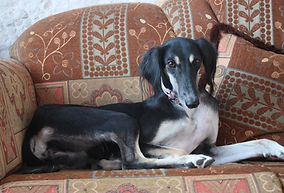
PRIZED HUNTER
Early drawings of the Saluki (as in the illustration from the early 1840s) show dogs with well developed feathering on legs and tail. However, they are depicted without the long feathering on the ears that is typical of the feathered-coat variety today. The Bedouin traditionally prize these dogs for their hunting powers rather than appearance. Salukis are used to hunt fast moving prey such as gazelle (giving rise to the alternative name "gazelle hound"), as well as fox and hare.

BREED STANDARD
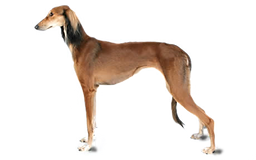
From a physical standpoint, the Saluki is almost a contradiction in terms elegant,strong, aristocratic and agile. Breeding and excellence were both defined by function. Excellent examples of a type of dogs were those which excelled in their work. Form truly followed function. The whole appearance of this breed should give an impression of grace and symmetry and of great speed and endurance coupled with strength and activity to enable it to kill gazelle or other quarry over deep sand or rocky mountain.
Salukis are racing kings in the dog world and when in perfect physical condition can run up to 60 miles per hour and continue for around 5 miles.
There are two varieties of Salukis:
Feathered has slight feathering on the legs, back of the thighs, and ears.
Smooth has no feathering. The coat on both is smooth, soft, and silky and comes in variety of colors.

HEAD Long and narrow, the whole showing nobility.
CRANIAL REGION :
Skull : Moderately wide between ears, not domed.
Stop : Not pronounced.
FACIAL REGION
Nose : Black or liver brown.
Jaws/Teeth : Teeth and jaws are strong with a perfe ct, regular and complete scissor bite.
Eyes : Dark to hazel and bright, large and oval, but not prominent. The expression should be dignified and gentle
with faithful and far-seeing eyes.
Ears : Long and covered with long silky hair, set on high, mobile, hanging close to the skull.
NECK: Long, supple and well muscled.
HINDQUARTERS
General appearance : Strong, showing galloping andjumping power.
Upper and lower thighs : Well developed.
Stifle : Moderately bent.
Hocks : Well let down.
Hind feet : Similar to front feet.
GAIT / MOVEMENT: smooth, flowing and effortless at trot.
Light and lifting showing both reach and drive with
out hackney
action or pounding.
COAT
Hair : Smooth and of a soft, silky texture, feather
ing on the legs and at the back of thighs, feathering may be present on the throat in adults, puppies may have slight woolly feather on thighs and shoulders. The smooth variety has no feathering.
Color : Any colour or combination of colours is permissible.
Brindles are undesirable.
LIMBS
FOREQUARTERS :
Shoulders : Well laid back, well muscled without being coarse.
Upper arm : Approximately equal in length to the shoulder blade and forming a good angle with it.
Forearm : Long and straight from elbow to wrist.
Pasterns : Strong and flexible, slightly sloping.
Front feet : Feet of moderate length, toes long and well arched, not splayed, but at the same time not cat-footed; the whole being strong and supple; feathered between the toes.
FAULTS
Any departure from the foregoing points should be considered a fault and the seriousness with which t he fault should be regarded should be in exact proportion to its degree and its effect upon the health and welfare of the dog.
DISQUALIFYING FAULTS
Aggressive or overly shy dogs.
Any dog clearly showing physical of behavioural abn
ormalities shall be disqualified.
Male animals should have two apparently normal test
icles fully descended into the scrotum.
Only functionally and clinically healthy dogs, with
breedtypical conformation should be used for breeding.